
Why the Innsbruck Nordkette Belongs in Your European Itinerary
A destination spotlight for Southeast Asian tour operators
Twenty minutes from Innsbruck's old town, your clients will be standing at 2,300 meters, looking out over the Tyrolean Alps. No hiking required. No special gear. Just a cable car, a clear day, and a view most of them have never seen anything like. Here is why it works and how to position it for your market.
Innsbruck already appears on many Southeast Asian itineraries, usually as a stop between Munich and Vienna. What most tour operators are not yet fully using is the mountain directly behind it.
The Nordkettenbahnen is a cable car system that runs from the center of Innsbruck to 2,300 meters in around twenty minutes. Three stages - the underground Hungerburgbahn, then the Seegrubenbahn, then the Hafelekarbahn - take your clients from a cobblestone street in the old town to a mountain panorama that stretches across the entire city and the surrounding Alpine peaks.
The stations were designed by Zaha Hadid. They are architecturally striking, and your clients will photograph them before they even board.
What happens at the top
Most of Southeast Asia is flat, coastal or tropical. Even travelers who have seen mountains at home rarely encounter this particular combination: a European alpine city far below them, a snow-dusted ridge behind them, and a silence that surprises nearly everyone who steps off the cable car.
The cold hits first. Then the scale of it. Then the view.
That contrast - arriving by cable car after a morning in the city, stepping into thin mountain air with Innsbruck laid out beneath you like a map - is what stays. Not just as a photograph, but as the moment of a trip. For many of your clients, this will be their first alpine experience. The Nordkette offers that first time in a format that asks nothing difficult of them: no preparation, no physical effort, no uncertainty. Just arrival.
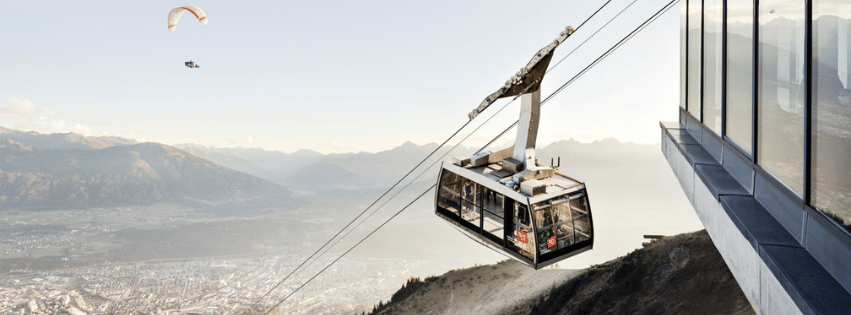
© Moritz Orgler
By market: who this is for and how to sell it
Singapore
Singaporean travelers are experienced. Many have been to Europe before, they compare itineraries carefully, and they are often looking for something that feels considered rather than simply famous. The Nordkette fits this precisely. Innsbruck itself is not the most obvious stop on a standard European tour, and the cable car - with its Hadid-designed stations and rooftop panorama at almost 2,100 meters - feels like a discovery rather than an obligation. For premium FIT packages and corporate incentive groups, this positions well as the highlight that others missed.
Thailand
Thai travelers respond strongly to natural contrast - the clean mountain air, the visual scale, the sense of distance from city heat and density. Bangkok's affluent FIT market increasingly seeks European nature experiences that go beyond urban sightseeing, but within an itinerary that does not require physical effort. The Nordkette delivers exactly this. For families traveling with older relatives or young children, the accessibility makes it genuinely inclusive: the cable car is enclosed and comfortable, there are restaurants at the top, and no difficult terrain is involved at any point. Everyone goes, everyone arrives, everyone has the same view.
Vietnam
Vietnamese group travel runs on clear itinerary logic. Each stop needs to deliver a definitive shared experience - something the group takes home together, not just individually. The Nordkette works because the payoff is immediate and collective. Everyone sees the same panorama from the same platform. Every phone comes out at the same moment. For group organizers, the operational predictability is also a real advantage: the cable car schedule is reliable, the time on the mountain can be planned precisely, and there is no element that risks leaving part of the group behind.
Malaysia
Malaysian travelers plan carefully and value destinations that offer a range of experiences within a short radius. Innsbruck with the Nordkette delivers this efficiently: old town, history, Alpine air and mountain panorama without adding a full extra day to the itinerary. For families, the combination carries particular weight - children experience cold mountain air and often snow for the first time, while parents get the European city atmosphere they came for. It fits naturally into a Salzburg–Innsbruck–Vienna routing without forcing a difficult choice about time.
For your itinerary planning
A half-day is enough. Most groups spend sixty to ninety minutes at the top - a coffee at the Seegrube restaurant, photographs at the panorama terrace, time to simply stand and look. The return descent takes another twenty minutes. Combined with a walk through Innsbruck's Altstadt and the Golden Roof, this is a complete and memorable stop that requires very little logistical effort.
The experience runs year-round. In winter there is snow on the ground at the top and Innsbruck visible below through cold clear air. In summer the mountain light is different - wildflower meadows, longer days, the city shimmering in the valley. Both seasons have their audience, and both photograph differently.
Ultsch Consult supports European destinations and tourism providers in reaching Southeast Asian tour operators - with direct market presence in Thailand, Vietnam, Malaysia and Singapore.
